

At Any Cost
Deportation doesn’t necessarily improve safety

Politicians harp that deporting migrants who have committed crimes makes the United States safer. El Mencho’s life story offers a deadly alternative.

Nemesio Rubén Oseguera Cervantes, best known by his nickname “El Mencho,” died over the weekend in a bloody firefight at a wooded retreat in the Mexican state of Jalisco. Mexican troops and National Guard personnel stormed El Mencho’s rented cabin in a dramatic attack on one of the globe’s most important crime figures. After an intense confrontation between troops and El Mencho’s bodyguards, the leader of Cartél Jalisco Nueva Generación reportedly died enroute to a medical facility.
Despite his fame as a brutal and sophisticated leader of a transnational cartel based in México, El Mencho was once nothing more than a low-level dealer in the illicit drug economy’s epicenter: the United States. Police in San Francisco arrested him in 1986 for trying to sell a small amount of crystal meth, according to a news report. He was back in the San Francisco jail three years later. Immigration officials deported him after each jail visit, only for El Mencho to return.
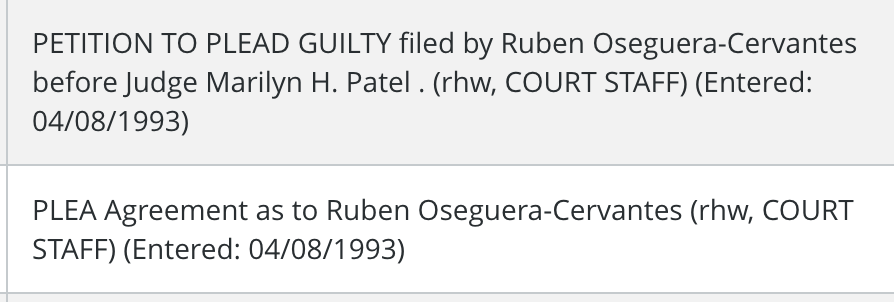
In 1992, he was arrested one more time in San Francisco when, along with his brother, he tried selling heroin to undercover officers. He pleaded guilty in April 1993 and received a five-year prison sentence.
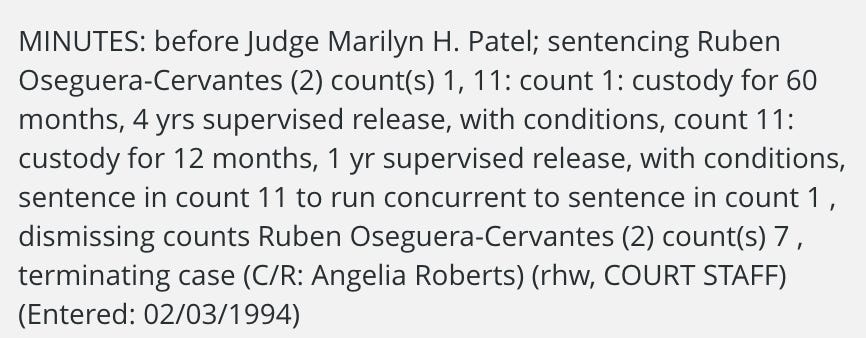
After completing that sentence, he was reportedly deported yet again and appears to have remained in México since then.
Targeting migrants who commit crime is a popular pastime for politicians. This week, President Trump criticized “public officials who block the removal of criminal aliens, in many cases drug lords.” Years earlier, President Obama explained that his administration targeted “[f]elons, not families. Criminals, not children.”
Since the middle of the 1980s, Republicans and Democrats alike have consistently supported proposals to make it easier for immigration officials to identify, detain, and forcibly remove from the United States people who have a run-in with police. In 1986, for example, Congress, working with President Reagan, enacted the Anti-Drug Abuse Act with bipartisan support, giving immigration officials the power to request that local law enforcement agencies detain people suspected of violating immigration law and of committing a drug crime. Two years later, Reagan signed the Anti-Drug Abuse Act of 1988 defining drug trafficking as a type of aggravated felony and, for the first time, requiring deportation upon conviction for an aggravated felony. A full decade later, President Clinton signed the Anti-Terrorism and Effective Death Penalty Act and the Illegal Immigration Reform and Immigrant Responsibility Act, laws that expanded the number and type of crimes that lead to immigration imprisonment and forced removal.
El Mencho appears to have gotten his start in crime during this period. Even without detailed information about his convictions, it’s clear that he would have been eligible for detention and deportation as a so-called “criminal alien”. His horrific career trajectory reveals just how it is that ever more hardline immigration policies seldom improve public safety. Rather than quashing his budding interest in crime, deportation appears to have opened opportunities that were not available in northern California. Moving throughout western México after deportation, he tapped existing criminal enterprises and took advantage of weak state security infrastructure. In Tijuana, for example, he developed a cross-border smuggling business while nurturing relationships with leaders of what was then a prominent Mexican criminal organization. For a while he worked as a police officer in Jalisco. Later, he returned to his hometown in the state of Michoacán where he married into an existing cartel and began rising through the ranks.
In Welcome the Wretched, my most recent book, I described how the immigration policies that the United States adopted in the 1980s and 1990s helped fuel Mara Salvatrucha 13 from a small-time gang in California to a transnational menace. Key MS-13 leaders got their feet wet in California, the same budding drug market in which El Mencho worked in his late teens and early twenties.
MS-13’s growth from an afterthought in California to a ruthless behemoth that has destabilized large parts of Central America played out differently from El Mencho’s formation of his cartel, but the two share an important feature: planted in fertile soil, deportation allowed criminal tendencies that sprouted in the United States to mature. “The violence of 1980s drug policing becomes the violence of 1990s gang-member deportations, which then becomes the twenty-first century violence of MS-13 attacks and forced displacement,” I write in Welcome the Wretched.
Like with MS-13, deporting El Mencho to México didn’t improve public safety here, there, or anywhere else. Instead, El Mencho’s life after deportation reveals “the fantasy that deporting migrants who commit crime removes a problem without creating a new one. It doesn’t now, and it never has.”
DHS press releases re criminal immigrant deportations usually tell us they were previously deported—showing the failure of deportations as a solution to crime
So, what is the solution?