

ICE Versus Schools
Teachers and students have a long history of keeping immigration agents out of schools

On a cool morning in November 1991, high school football coach Benjamin Murillo drove across El Paso, Texas to watch his Bowie High students take on competing Jefferson High School when two Border Patrol agents stopped him. With a gun pointed at Coach Murillo’s head, one agent asked about his citizenship status. The coach asked the agent to put down his gun. There were two student athletes in the car with him and he worried someone might be shot, he later recalled in a lawsuit challenging the Border Patrol’s frequent harassment of Bowie students and staff.
A few months later, Border Patrol agents followed a car filled with students into the school parking lot and surrounded it. The teenagers all said that they were U.S. citizens or permanent residents. Agents arrested them anyway.
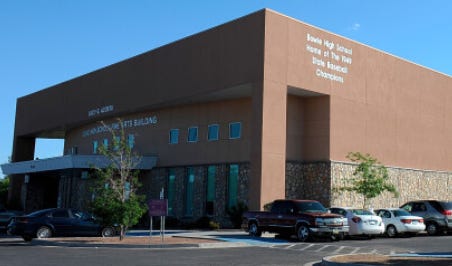
Within eyesight of Ciudad Juárez, El Paso’s neighbor on the Mexican side of the boundary line, in the 1980s and early 1990s Bowie High School was a hub of Border Patrol activity. Federal officials had built a wall along this urban stretch of the U.S.-Mexican border and used it to push migrants towards the high school.
“The Border Patrol left holes largely unrepaired in the border fence on top of the nearby river levee, as a means to funnel undocumented border crosser traffic through this relatively open area, where agents would have a better chance of spotting and apprehending suspects,” writes Timothy J. Dunn in Blockading the Border and Human Rights.
In 1992, the Bowie High students and teachers who sued the Border Patrol convinced a court that agents violated the Fourth Amendment’s prohibition against unreasonable searches and seizures as well as the Fifth Amendment’s bar against discriminatory treatment.
One year later, the Immigration and Naturalization Service, which included the Border Patrol at the time, announced that it would stop targeting schools. Agents should avoid arresting people at schools, places of worship, and funerals, Acting Association Commissioner James Puleo wrote, unless a high-ranking officer gives prior written approval. Even then, approval should be denied if similarly effective alternatives are available.
When the Trump administration announced that immigration agents should feel free to search for and arrest people inside schools and places of worship, a position Trump’s advisors hinted at in December, it marked a departure from longstanding practice. For more than thirty years, immigration officials have held back from targeting schools and places of worship no matter who occupied the Oval Office.
Denver school leaders would like to keep it that way. School officials worry that a large immigration enforcement operation led by ICE kept kids away from school. Classrooms typically filled with as many as 35 students saw attendance drop to as few as seven students after the February operation, one elementary school teacher said in court documents. When the district superintendent arrived at a nearby school to meet with frightened children and parents, “students responded fearfully because they worried he was an immigration official,” the lawsuit claims. Four Denver students were detained, as were the parents of two other children, the superintendent said.
The lawsuit claims that DHS failed to explain why it needs to change policy. The Administrative Procedure Act requires federal agencies to explain themselves whenever they alter policies. A different federal law, the Freedom of Information Act, requires agencies to make policy documents publicly available. DHS failed to explain why it is deviating from three decades of past practice and it failed to make its new policies publicly available, the district argues.
Justice Department lawyers argue that the school district doesn’t have a legal basis to sue. They claim that ICE can enforce immigration law how it pleases with few constraints. Plus, Congress never intended to keep immigration agents out of schools, the federal government lawyers told a Denver court last week.
The judge overseeing the Denver lawsuit hasn’t issued any rulings yet, but a federal court in Maryland blocked ICE’s policy shift earlier this week in a lawsuit brought by religious groups. The Trump team’s willingness to target places of worship has injured the religious organizations by reducing attendance at religious services and English classes offered as part of the worshippers’ faith, the court concluded.
The religious groups convinced the Maryland federal court that ICE’s new policy hinders their First Amendment right to freely express their faith commitments and the government failed to explain how the new policy “furthers a compelling state interest” and can’t be accomplished through a less burdensome alternative. Unless they have an administrative or judicial warrant, ICE agents must stay away from churches, synagogues, mosques, and other places of worship operated by the three faith communities who said DHS.
Though these lawsuits both challenge the Trump administration’s about-face on enforcement actions near sensitive locations, they raise different legal issues. The religious groups claim that they have a legal right to worship, and ICE’s new policy interferes with that right without offering any good reason.
By contrast, the school district takes issue with the process by which ICE shifted gears. Its lawsuit does not raise any claim of a legal right to accessing schools. This is a notable omission considering the Supreme Court position that children have a constitutional right to attend public schools regardless of their citizenship or immigration status. “If the State is to deny a discrete group of innocent children the free public education that it offers to other children residing within its borders, that denial must be justified by a showing that it furthers some substantial state interest,” the justices explained in its 1982 decision Plyer v. Doe.
Unlike Plyler, in which school-age children sued the East Texas district that tried to bar them from enrolling, the lawsuit brought by Denver Public Schools against DHS doesn’t involve children. As such, the school district would be on much weaker footing were it to raise a constitutional claim about the kids’ access to schools. Courts are typically skeptical of one party raising a legal claim on behalf of another. I wouldn’t be surprised to see a lawsuit soon in which children sue DHS over its new policy, especially if ICE continues arrests near schools or begins entering schools.