

Jurisdictional Evasion
How mandatory detention keeps people detained with little to no opportunity to be heard

By Rebecca Galemba and Ella Iveslatt
Since the spring of 2025, immigration courts, and, more recently U.S. Circuit Courts of Appeals, have become battle grounds over the future of mandatory detention of migrants. In July 2025, DHS and Justice Department policy expanded mandatory detention to any noncitizen who entered the country without authorization, making them ineligible to seek bond from an immigration judge. After observing immigration bond hearings for six months, we’ve seen how the expansion of mandatory detention has prolonged detention, decimated release on bond, and pressured detained immigrants to abandon their claims for relief and request voluntary departure and even removal.

Since last October, we have been running a Court Transparency Project with University of Denver students and the Colorado Asylum Center. At Aurora, Colorado’s detained immigration court, we have documented 450 master calendar hearings and 111 bond hearings. Judges only set a bond in 24 percent of bond hearings we observed.
Was a bond set during the hearing?
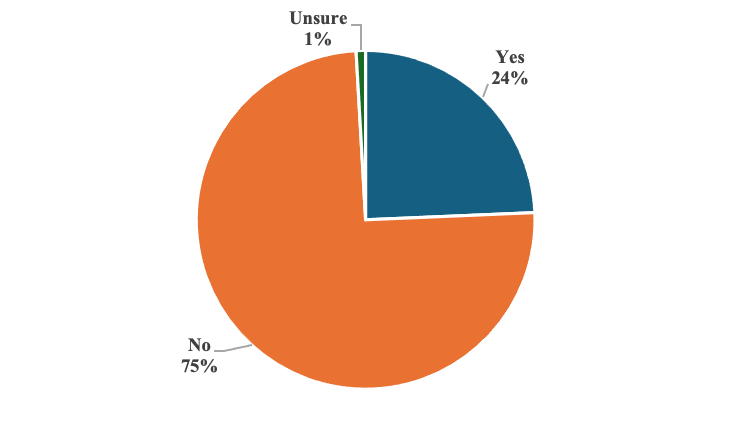
We attempted to track bond hearings over time because some judges issued decisions later in the day. We also learned that ICE appealed some bonds set in the courtroom. These individuals remained detained; some requested voluntary departure at a subsequent master calendar hearing. The largest portion of bond denials — 47 percent — were because of lack of jurisdiction, the majority of which resulted from the expansion of mandatory detention.
If a bond was not set during the hearing, what was the reasoning?
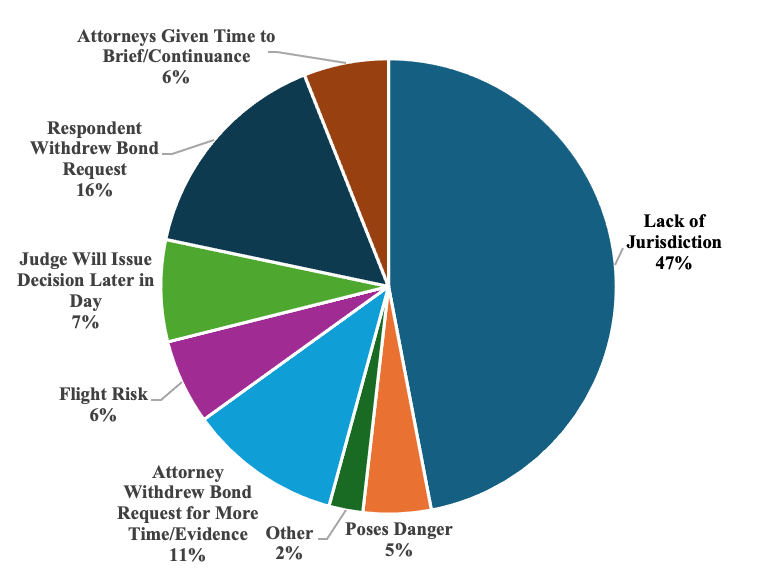
Denial by lack of jurisdiction
On December 11, 2025, an attorney represented a Colombian man, Roberto (a pseudonym), who was detained at ICE’s immigration detention center in Aurora, in his bond hearing. This was Roberto’s second attempt to request bond. The immigration court had previously concluded that it couldn’t consider releasing him because it lacked jurisdiction. This time around, Roberto’s attorney argued that a case making its way through a federal court in California, Maldonado Bautista v. Santa Cruz – in which the federal court entitled detained migrants who were denied bond hearings based on the new DHS mandatory detention policy the right to request them– made all the difference.
Roberto’s attorney argued, “Once class membership is shown, immigration judges must follow it.” However, the attorney representing DHS opposed, arguing that class membership [in Maldonado Bautista] did not change the fact that Roberto was still ineligible for bond: “The court does not have jurisdiction [to consider bond] based on his manner of entry.” Roberto had originally entered the country without authorization.
The judge agreed with DHS. He stated that “declarative guidance has not been issued [around the Maldonado Bautista certification]…it’s not a matter of changed circumstances. I lack jurisdiction.” There was no mention of the factors that judges usually consider in bond hearings: Roberto’s community ties, his eligibility for immigration relief, employment, tax records, information about the person sponsoring his visa application, or whether he was a flight risk or danger to the community. His attorney never got an opportunity.
DHS attorneys continued to oppose bond in cases like Roberto’s. They insisted that any migrant who entered without inspection and was subsequently detained, even years later and far from the border, was subject to mandatory detention. By classifying them as “applicants for admission,” DHS was treating migrants apprehended in the interior after years of living in the country as if they just arrived at the border seeking admission. Previously, those living in the interior were “categorized under a different statute that allowed them to seek a bond hearing before an immigration judge…” Despite years of established practice and federal court rulings declaring the DHS policy illegal, immigration judges largely deferred to DHS’s new interpretation. (Since then, the Ninth Circuit blocked the ruling from going into effect while the government appeals). Roberto requested pre-conclusion voluntary departure at his master calendar hearing the same day.
High Representation, Low Access to Bond Hearings
Migrants who requested release on bond during our observations were almost always represented — 89.2 percent received legal assistance. This rate is extremely high given only 39.6 percent were represented in our master calendar sample. This disparity reflects the difficulty of getting a bond hearing without an attorney. In master calendar hearings, we often heard individuals representing themselves ask judges, “I would like to leave the detention center because I have not committed any crimes.” “I am still afraid, but instead of being here, detained, I’d rather be there [home country].” “Is there a bond?”
In every unrepresented bond case we observed, the respondent withdrew their bond application because they had not filed evidence. Judges only explained evidence requirements after they failed to comply, instructing them that the only option was to withdraw their bond request so they could submit again, as once a denial is issued, there are no opportunities to try again. However, most requested voluntary departure instead.
Judges explained, but few understood, that they needed to wait because bond hearings are separate from hearings in which judges decide if a person will be allowed to remain in the United States. One instance made this disconnect apparent when a man was submitting pleadings at his master calendar hearing. Although he had a lawyer for his bond hearing, now he was unrepresented. He requested voluntary departure because he had no other means of relief if he did not want to stay detained. However, he asked the judge, “what about my bond?” The judge was confused, “Who gave you a bond?” “You did…last week,” he answered. His removal proceedings outpaced his ability to post his bond without attorney assistance.
High Human and Financial Cost
The DHS policy of expanded mandatory detention conflicts with years of established practice, is widely considered to be “legally flawed,” and according to attorney Mike Baker, used the “most extreme interpretation possible,” and…create[d] the exact due process violation the Supreme Court [has] warned against…indefinite detention based on status rather than individual dangerousness or flight risk.” Mandatory detention inflicts unnecessary financial costs and bureaucratic hurdles, burdening federal courts and attorneys with thousands of habeas petitions as the detained population mirrors the impact of indiscriminate arrests and racial profiling. As of early 2025, about “90 percent of people ICE detains were held in facilities either owned or operated by private prison companies” under ICE contract, like Aurora’s GEO Group-owned detention center, which costs about $194.18 per adult contract bed per day. The vast majority of currently detained immigrants have no criminal record and more than one-third – 34.4 percent – of respondents we observed had already filed applications for relief, including asylum and family-based petitions.
The human costs of mandatory detention tear apart families and communities. One man in detention had been living in the United States for 25 years with no criminal record. His son, an active member of the military, sponsored his immigration application. Yet each day he spends detained, his wife suffers from stage four cancer while caring for their U.S.-born daughter alone. He was the breadwinner, a pattern echoing through our observations in Aurora. The judge granted him a $5,000 bond in March, but ICE likely appealed because he was not released. He was granted voluntary departure in early May with an appeal due in thirty days. He is still detained. His case is not unique. Roughly 80 percent of cases we observed involved men.
The future of mandatory detention poses implications for due process and executive power over the immigration court system. As ICE agents have adopted brazen and violent tactics with little to no accountability to fulfill their mandate to “arrest and detain as many people as possible,” the expansion of mandatory detention makes it increasingly difficult to secure release once detained. Although nearly 90 percent of bond hearings we observed had representation, three-quarters still did not receive a bond in the courtroom. More concerning, the largest portion were because of lack of jurisdiction, meaning that neither the respondent nor their attorney had a meaningful opportunity to present their merits for release. For those who received bonds, amounts could reach as high as $40,000 to $50,000 when the only concern was a stable address.
When executive power so blatantly undermines judicial independence, due process is eviscerated, and policies are designed to deprive individuals of their liberty with few ways to challenge it, there is no guarantee that anyone will be spared.
Rebecca Galemba is a Professor at the Josef Korbel School of International Studies and Co-Director of the University of Denver Center for Immigration Policy & Research (CIPR). She is the Principal Investigator of the DU Court Transparency Project. Ella Iveslatt is a graduate from the University of Denver (BA in International Studies and Economics, ‘24) and is planning to attend law school. She is the Project Manager of the DU Court Transparency Project.