

Reaching Safety
Supreme Court seems poised to let immigration officials repeat deadly mistakes of the past

On my way to Phoenix for a series of lectures recently, I arrived at the city’s airport the moment my flight touched down. Later, I jumped into a car and arrived at a hotel when the car pulled up in front. The following day, I arrived home when I exited another car, stepping foot onto the sidewalk in front of my house. All of us arrive in one place or another daily but teasing out when someone arrives in the United States takes on extra importance when it means the difference between requesting asylum and being blocked from safety.
Last month, the Supreme Court considered what Congress meant when it passed a law allowing anyone who “arrives in” the United States to apply for asylum and another law requiring that immigration officers process asylum requests from anyone “arriving in” the country. The court’s decision in Noem v. Al Otro Lado will likely impact how presidential administrations respond to migrants hoping to request asylum and, in turn, how migrants respond to federal immigration officers.
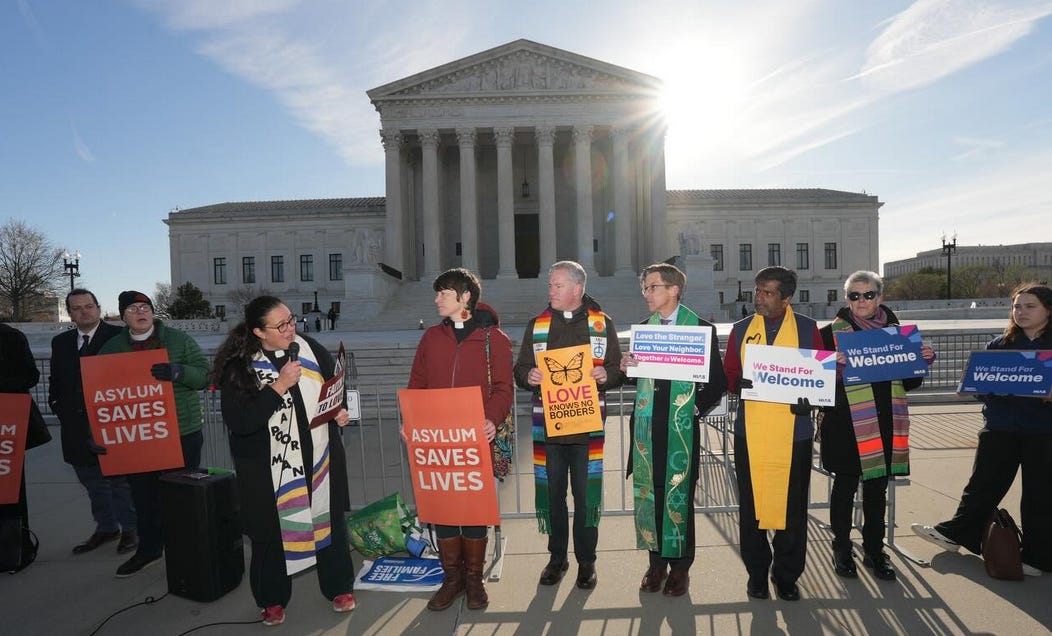
The Trump administration urged the justices to draw a bright line at the international boundary. “You can’t arrive in the United States while you’re still standing in Mexico,” Vivek Suri, a Justice Department lawyer, argued. Kelsi B. Corkran, who represents the immigrant rights group Al Otro Lado, disagreed. “They are arriving, present tense. Once they’re inside, they’ve arrived, past tense,” she explained.
Starting at the end of the Obama administration, DHS positioned Customs and Border Protection officers at the literal border to prevent migrants from stepping foot in the United States to request asylum. A federal appellate court found that this policy, called “metering,” violates immigration law. The Trump administration is currently not metering (it has adopted other policies that effectively cut off access to asylum), but it wants to have the option available in the future.
The justices’ comments at oral argument suggest that they are likely to side with the Trump administration. Justice Samuel Alito, part of the court’s rightwing majority, left little doubt that he agrees with the administration when he asked Corkran, “Do you think someone who comes to the front door of a house and knocks at the door has arrived ‘in’ the house?” Before she could answer, Alito added, “The person may have arrived ‘at’ the house.” Alito’s frequent ally, Justice Brett Kavanaugh, explained that the court shouldn’t concern itself with the likely real-world impacts of a decision in the administration’s favor.
If the court allows immigration officials to prevent people from requesting asylum by physically blocking them at the international boundary, many migrants are likely to avoid walking into a port-of-entry where officials are stationed. Instead, they are likely to enter the United States unlawfully by whatever means available. This is exactly what happened when immigration officials previously blocked access to ports-of-entry. Metering incentivized illegality because, for people seeking asylum, the alternative is worse.
Passengers of the M.S. St. Louis learned this in the most horrible of ways. Fleeing death in Nazi-controlled Europe, over 900 Jews boarded the St. Louis in 1939 and headed toward Cuba. While the ship steamed across the Atlantic, Cuban officials had a change of heart. They revoked the landing permits that had been issued to the passengers. Unable to land in Havana, the ship’s captain eventually steered the St. Louis northward toward Florida, hopeful that in the United States they would find safe harbor.
Despite political pressure by Jewish advocacy groups, the Roosevelt administration also refused to let the ship dock in the United States. At the time, U.S. immigration law capped the number of migrants who could come into the United States from a given country, and the ship’s passengers hadn’t reached the top of the list. No other country in the Americas let them land either. With nowhere to go, the St. Louis returned to Europe where the death they fled awaited. “Two hundred fifty of the people who stood on the St. Louis in 1939 watching Miami’s lights twinkle in the distance as they waited for permission to enter the United States, permission that never came, didn’t survive their forced return to Europe,” I wrote in Welcome the Wretched, my most recent book.
When death reached Miami’s shores, immigration law restrictions quashed the life-saving power of welcome. The immigration laws at the center of the metering policy dispute didn’t exist in 1939. They were enacted in response to the world’s failure to prevent the Holocaust.
A decision in favor of the Trump administration will increase the likelihood that the United States will repeat the moral stain represented by the deaths of the St. Louis passengers. Some people, stuck in dangerous Mexican border cities where they are easy prey, are likely to die as they try to comply with U.S. requests to wait. Blocked from asking for asylum within the safety of a U.S. port-of-entry, others will die as they take more risk to sneak into the United States. Still more will be abused and extorted, harms short of death, but avoidable harms nonetheless.
The court’s decision in Al Otro Lado is expected in June or July.