

Texas Against the U.S. Constitution
Federal court puts Texas migration law one step closer to constitutional reckoning

When Texas Governor Greg Abbott signed a bill three years ago creating two migration crimes and a state-level deportation process, he left no doubt that he knew he was putting the state on a constitutional collision course. Late last month, a federal appellate court pushed the governor’s plan closer to reality. The non-governmental organization and county government who had successfully sued to stop the state law from going into effect did not have a legal right to sue, the U.S. Court of Appeals for the Fifth Circuit announced in April.
[In a separate case, described below, a federal trial court last night blocked Texas from enforcing the law.]
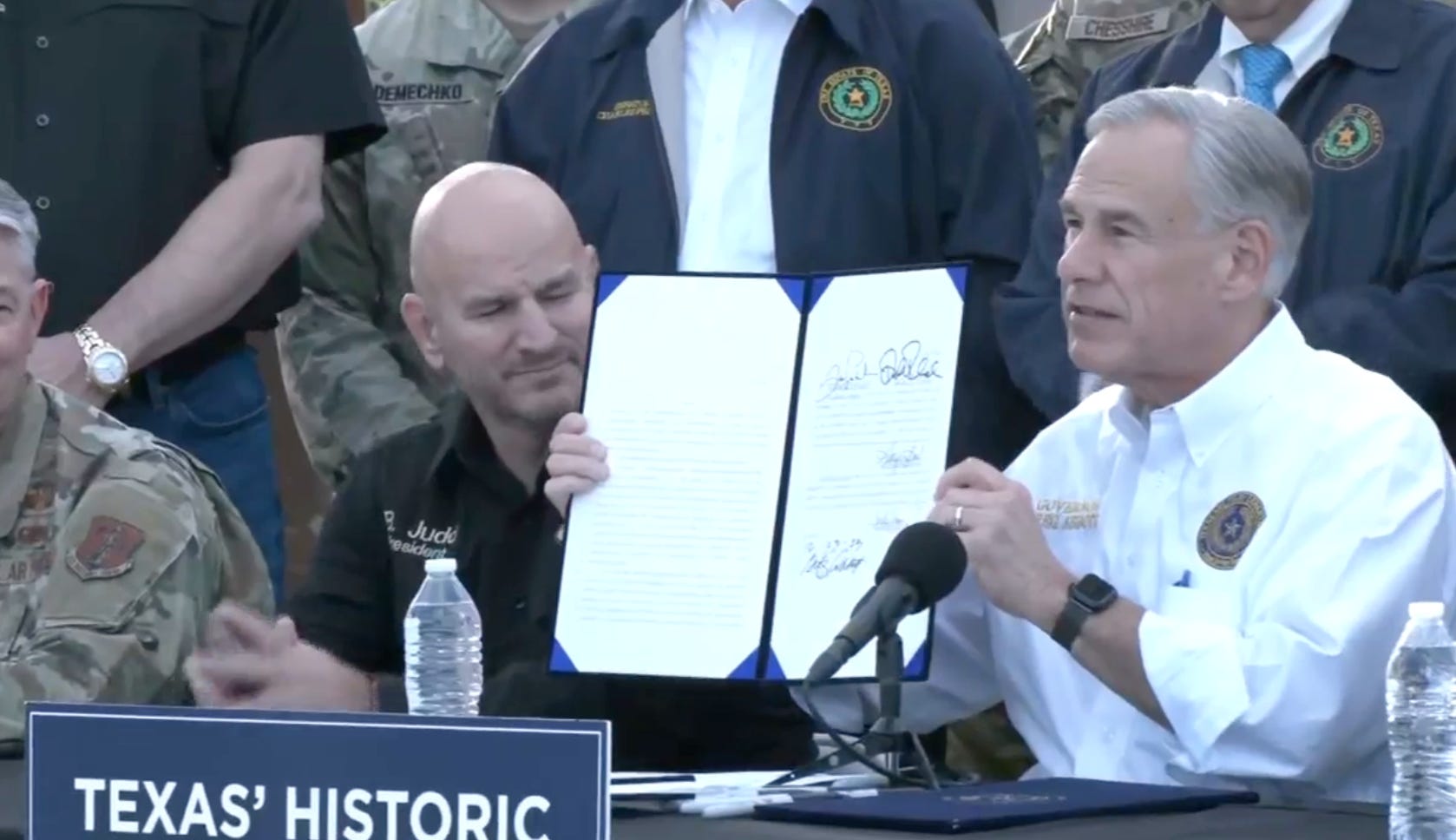
The state law, Senate Bill 4, which Abbott signed in December 2023, injects Texas directly into the migration control business. The law allows up to two years’ imprisonment for entering the United States without the federal government’s permission and as much as twenty years for reentering after having previously been deported or excluded from the country. Both are similar to federal crimes that have existed since 1929. Instead of sending a person convicted of these new state offenses to prison, S.B. 4 gives state judges the power to order them to leave the United States.
An immigration legal services provider in El Paso, Las Americas Immigrant Advocacy Network, and the El Paso County government sued the state. They argued that S.B. 4 violates the U.S. Constitution’s position that a state law can’t be allowed to conflict with federal law. Since the Supreme Court has long taken the position that migration regulation is the responsibility of the federal government, Las Americas and El Paso County argued that S.B. 4 is unenforceable under the Constitution’s Supremacy Clause, which states that federal law “shall be the supreme law of the land.” A federal district court judge agreed with the challengers and blocked Texas officials from enforcing S.B. 4. A divided three-judge panel of the U.S. Court of Appeals for the Fifth Circuit backed the lower court.
Last month, the full Fifth Circuit took a different approach. Without addressing whether S.B. 4 is unconstitutional, ten of seventeen judges on the full appellate court announced that Las Americas and El Paso should not have been allowed to sue in the first place. Neither showed that they were injured by S.B. 4, a constitutional requirement to sue, the majority of judges on the nation’s most rightwing federal appellate court announced in Las Americas v. Martin. The legal principle of standing requires a party filing a lawsuit to show that they have been injured in some concrete way by the law or policy they are challenging.
Las Americas argued that they would be injured by S.B. 4 because the new law would require that they shift money and staff from their current projects to address the criminal prosecutions that would likely begin if the court allows state officials to implement it. The Fifth Circuit rejected that argument, explaining that Las Americas “cannot ‘spend its way into standing’ or ‘manufacture its own standing’” by choosing to defend people targeted by S.B. 4.
The appellate court also rejected the county government’s claim that its reputation would suffer, and it would take on additional expenses, including for more jail space, if required to enforce S.B. 4. “Reputational harm is entirely subjective,” the majority concluded, before suggesting, without evidence, that the county might get a reputational boost in the eyes of people “opposed to the scourge of illegal immigration.” It then described as “highly speculative” the financial costs that the county worried about.
Having now lost at the full Fifth Circuit, the challengers have two options remaining. They can start from scratch with a new lawsuit on behalf of people who stand to be targeted directly by S.B. 4 or they can ask the Supreme Court to add the case to its docket during the term that begins in October. Filing a new lawsuit is risky because it turns anyone who challenges the law into a target for federal immigration officers (though that risk can be minimized if a judge permits the person to sue under a pseudonym). It’s also slow.
The alternative path seems to be exactly what Abbott, the state’s governor, imagined when he signed S.B. 4 into law in 2023: go to the Supreme Court. Even though, just a few years earlier in a case challenging Arizona’s attempt to create its own immigration laws, the Supreme Court had repeated its longstanding position that immigration law is the responsibility of the federal government, Abbott said he thought there was room for Texas to create its own immigration laws. Speaking to reporters at the time, Abbott said, “Justice Scalia wrote a dissenting opinion in that case pretty much laying out a pathway that he thought would be a legal way for a state to go about the process of enforcing immigration laws.” In that case, Arizona v. United States, Scalia commented, “Arizona is entitled to have ‘its own immigration policy’—including a more rigorous enforcement policy—so long as that does not conflict with federal law.”
Abbott might now get his wish. Maybe by the end of this year, we’ll know whether Scalia’s dissent becomes the Supreme Court’s rule.
[Late yesterday, a federal judge in Austin announced that S.B. 4 does conflict with federal law. In L.M.L. v. Martin, Senior U.S. District Judge David A. Ezra, who issued the earlier ruling involving Las Americas and El Paso County, again found that the state law violates the U.S. Constitution. “SB 4 threatens the fundamental notion that the United States must regulate immigration with one voice,” Ezra wrote in a decision allowing a lawsuit by two migrants to move forward. Meanwhile, Ezra barred Texas from enforcing the law.]
Thanks for flagging this opinion — I think it’s flown a bit under the radar in light of other immigration litigation. ACLU-OK has a similar case out of the Tenth w pseudonymous plaintiffs & two orgs (https://www.aclu.org/cases/padres-unidos-de-tulsa-v-drummond) Based on the OAs, it seems like the Tenth will affirm the lower court’s PI. But the standing issue in particular has me queasy in light of the current makeup of SCOTUS.