

Walling Off Jesus
Catholic Church fights Trump administration’s plan to build a barrier through border pilgrimage site

It’s easier to feel close to God at 4,700 feet up. Maybe that’s why Monsignor Lourdes Costa, a Catholic priest near El Paso decided to build a 29-foot-tall statue of Jesus Christ on top of Mount Cristo Rey almost a century ago. Now the Trump administration wants to seal it off, setting off a legal fight with the Catholic Church. Running alongside the border that the United States and México share, the holy peak is one of the few remaining stretches of land near El Paso without a physical border barrier. If the Catholic Church gets its way, it will stay that way.
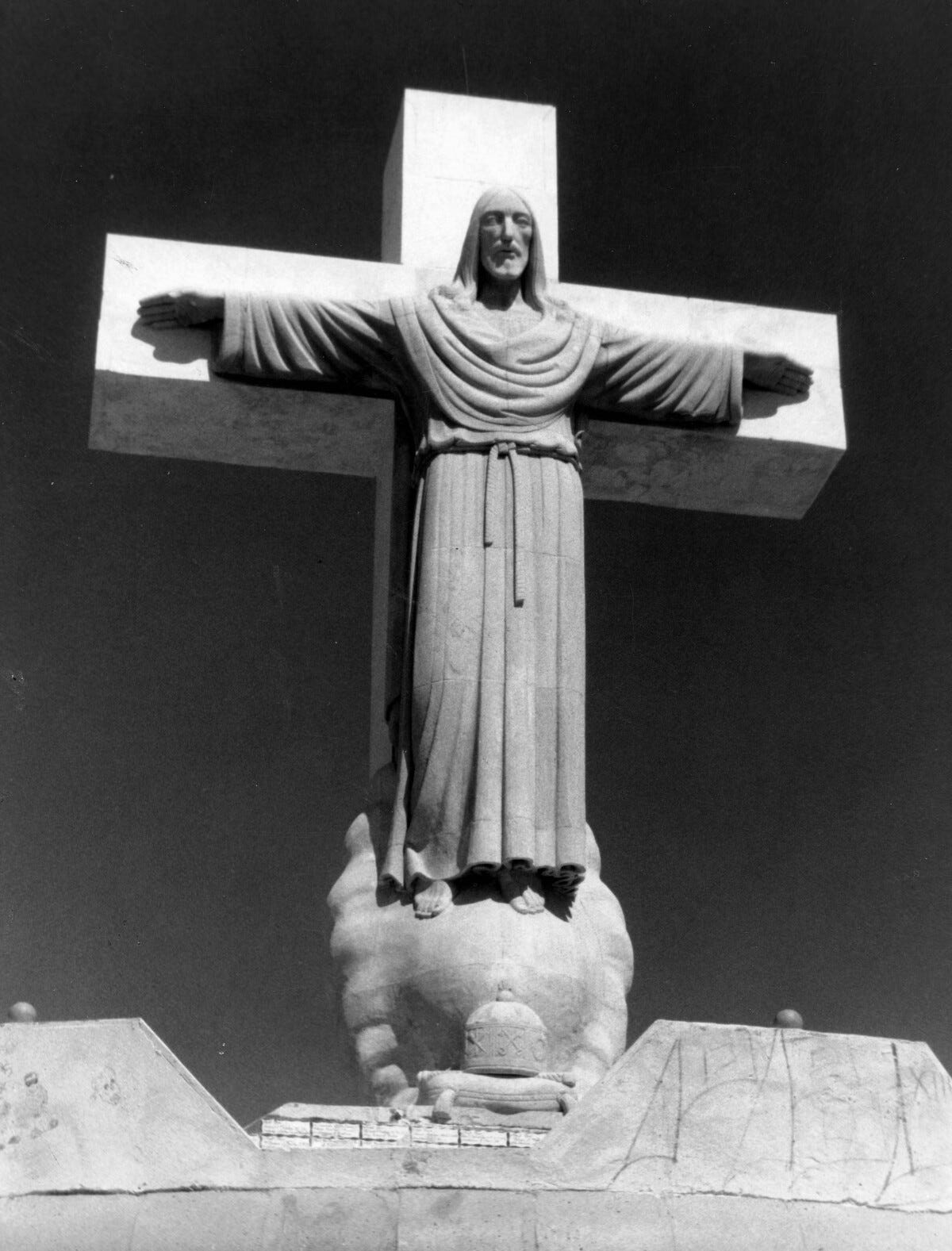
As a parish priest for the poor, Mexican community of Smeltertown – a community first made famous for its copper and lead smelter, then for its lead poisoning – Father Costa wanted something big to mark the 1,900th anniversary of Christ’s birth. It would take six years, but eventually local residents, supported by the Catholic Diocese of El Paso, got there in 1939. Since then, Catholics from throughout the region have made the two-mile walk from the mountain’s base to the Christ statue twice a year. “To be closer to God,” Javier Martínez said when asked why he joined thousands of other pilgrims to mark Good Friday earlier this year.
The mountain-top statue watches over two countries and three states – Texas, New Mexico, and Chihuahua. The Department of Homeland Security wants to build a wall around it, claiming it’s needed for national security. The Catholic Diocese of Las Cruces, which now owns the site, says it’s “a place of prayer where faith transcends borders.” Erecting a border wall through Mount Cristo Rey would destroy its sacred significance, the church adds. “A place of hope, faith, and communion would become a place of fear, exclusion and division,” church leaders told the Customs and Border Protection division of DHS last summer.
The Trump administration wants to move forward anyway. In early May, Justice Department lawyers informed the diocese that DHS planned to condemn approximately 14 acres of Mount Cristo Rey in exchange for $183,000. They claim, in United States v. 14.259 Acres of Land, that federal law gives it the power to take ownership of any property when “it is necessary or advantageous” to do so. A separate law automatically transfers title of the property to the federal government the moment that officials notify the existing owner and deposit the property’s estimated value with a federal court. With ownership in hand, DHS could begin blasting a pathway and building a barrier as soon as it likes.
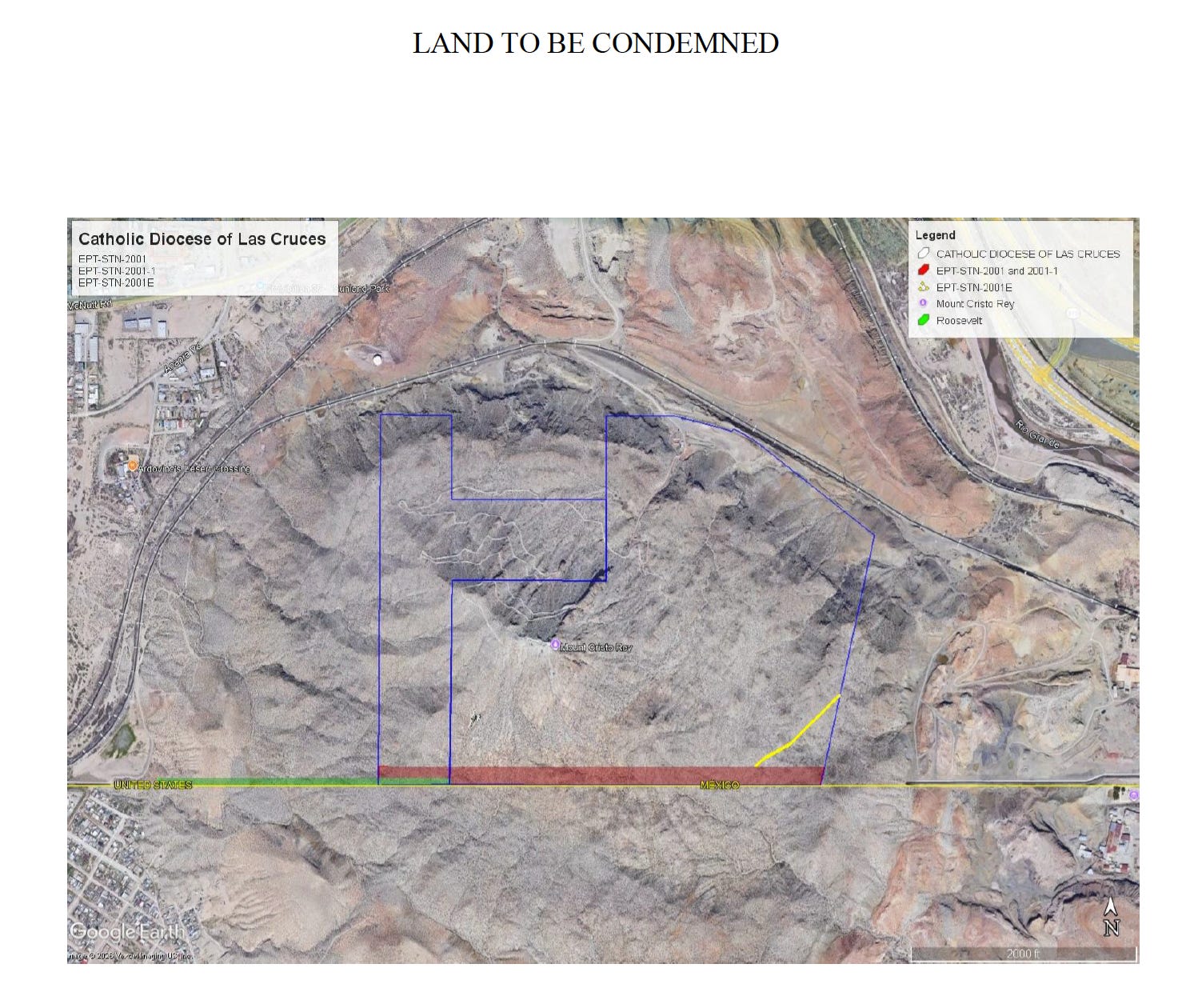
Concerned that the government will quickly cut off access to what church leaders describe as a “holy site,” the diocese has asked a federal court in Las Cruces to stop the government from depositing the land’s estimated monetary value into a court-approved account. Rather than simply delay the government’s acquisition of Mount Cristo Rey or increase the amount of compensation that DHS pays the church, the Diocese of Las Cruces wants to stop the government entirely. “The Government’s proposed taking will substantially burden the free exercise of religion by the Diocese, its parishioners, and the other faithful who seek to commune with God on Diocesan property,” lawyers for the diocese wrote to the court one day after the Justice Department announced its plan to seize control of the mountain.
The diocese claims that a sweeping law enacted by Congress in 1993, the Religious Freedom Restoration Act, prevents the government from blocking worshipers’ use of the site for their religious beliefs. The law bars the government from doing anything that would “substantially burden a person’s exercise of religion” unless the government can point to a “compelling governmental interest.” Even then, the government must adopt “the least restrictive means of furthering that compelling governmental interest,” the law requires.
Spearheaded by a young Representative Chuck Schumer and signed by President Bill Clinton, RFRA has become a darling of the religious right – with remarkable success. In 2014, Hobby Lobby successfully turned to RFRA to block a provision of the Affordable Care Act that required employers to pay for contraceptive access by their employees. A group of Hobby Lobby store owners who oppose abortion argued that contraceptives amount to abortion, so the ACA’s mandate would have forced them to pay for something that violated their religious beliefs. “RFRA was designed to provide very broad protection for religious liberty,” Justice Samuel Alito wrote in Burwell v. Hobby Lobby Stores on behalf of the majority of justices. “By enacting RFRA, Congress went beyond what this Court has held is constitutionally required,” Alito added.
Building off Hobby Lobby, the Catholic Diocese of El Paso claims RFRA is a “super-statute,” quoting the U.S. Court of Appeals for the Tenth Circuit’s decision in the Hobby Lobby case. The diocese could have noted that Justice Neil Gorsuch used that phrase in his concurring opinion in the Hobby Lobby case when he was a judge on the federal appellate court in Denver.
Now a federal judge in New Mexico has to decide whether blasting into a mountainside and building a steel-and-concrete border wall interferes with religious liberty at least as much as the ACA’s employer mandate did. A decision from the U.S. district court is likely to come soon.